
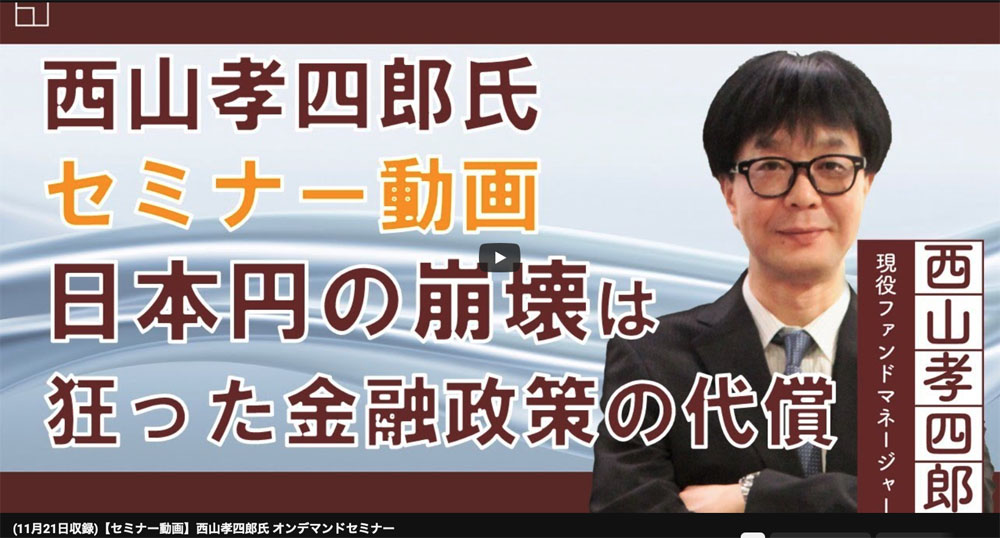
 Mr. Koshiro Nishiyama
Veteran fund manager Koshiro Nishiyama views the current US-Japan economy as a "debt-dependent Ponzi scheme" and warns that severe economic and market turmoil is likely to arrive heading into 2026.
In particular, his strong concerns regarding the fiscal policies advocated by Ms. Takaichi (mentioned as a political leader of the proactive fiscal faction) and his criticism of Modern Monetary Theory (MMT) are the primary points of contention.
The video has reached over 10,000 views within one day.
Analysis Overview
1. Ms. Takaichi's Fiscal Policy and Criticism of MMT
Nishiyama harshly criticizes the proactive fiscal policies advocated by those around Sanae Takaichi, calling them a dangerous gamble that ignores Japan's current economic reality.Contradictory Reality and the Dangers of MMT:
Takaichi's policy advisors justify fiscal stimulus through bond issuance based on Modern Monetary Theory (MMT), which claims there is no need to repay debt. However, Nishiyama points out that there has never been a successful historical example of MMT-like policies, and they ultimately lead to collapses similar to those in Zimbabwe or Argentina.Furthermore, regarding Takaichi's advocacy for large-scale fiscal stimulus (proposing a massive budget even in the absence of an emergency) based on the perception that "Japan is in deflation," Nishiyama argues this contradicts the reality of import-driven inflation caused by the yen's depreciation, where "the value of the yen has halved (effectively near hyperinflation)." He states that distributing cash during inflation is like "pouring oil on a fire" and deviates from economic common sense.
Conflict with the BOJ (Governor Ueda) and a "Checkmate" Situation:
In the video, the interaction between Ms. Takaichi and BOJ Governor Ueda (depicted as a symbolic conflict) is presented as follows:- Takaichi's side demands a massive supplementary budget (on the scale of 17 trillion yen) while suppressing interest rate hikes (continuation of Yield Curve Control).
- Governor Ueda's side expresses concern that further fiscal expansion and interest rate suppression will lead to the "collapse of the Japanese Yen."
- Even if Takaichi's side argues they should "sell US Treasuries (foreign reserves) to sell dollars" as a countermeasure against the weak yen, the US is unlikely to allow a massive sale of its debt, as it would trigger a collapse of the US dollar system.
2. "Financial Repression" and Stealth Taxation
Nishiyama argues that as a problem common to both Japan and the US, governments have neither the ability nor the intention to repay their bloated debts and are instead using a strategy of "inflation" to diminish the real value of debt (Financial Repression).- Inflation Tax: By maintaining policy rates below the inflation rate, real interest rates become negative, sacrificing the value of citizens' savings to reduce national debt. This is effectively a "tax increase" and merely a transfer of wealth from the private sector to the state.
- Fiscal Dominance: Because debt is so massive, central banks cannot raise interest rates. Not only Japan, but the US also carries $38 trillion in debt, creating a structure that cannot withstand rising interest rates.
3. The "Everything Bubble" and Market Outlook
He explains that the current market is in an "Everything Bubble" where stocks, real estate, and crypto assets are all rising, but this is not healthy economic growth; rather, it is a phenomenon caused by the deterioration of currency value (cash becoming trash).- Concerns over the AI Bubble: Specifically regarding AI-related stocks like NVIDIA, he compares the surge in market capitalization to the "South Sea Bubble" or the Tulip Mania, pointing out that valuations have reached levels that are common-sensically impossible. Even if profits are being generated, he believes a correction will eventually occur because expectations are abnormally high.
- The 2026 Crisis: He predicts that from late 2025 into 2026, as US central bank policies and political events such as the mid-term elections intertwine, the current bubble maintenance system (Ponzi scheme) will reach its limit, potentially leading to a major turning point in the markets.